
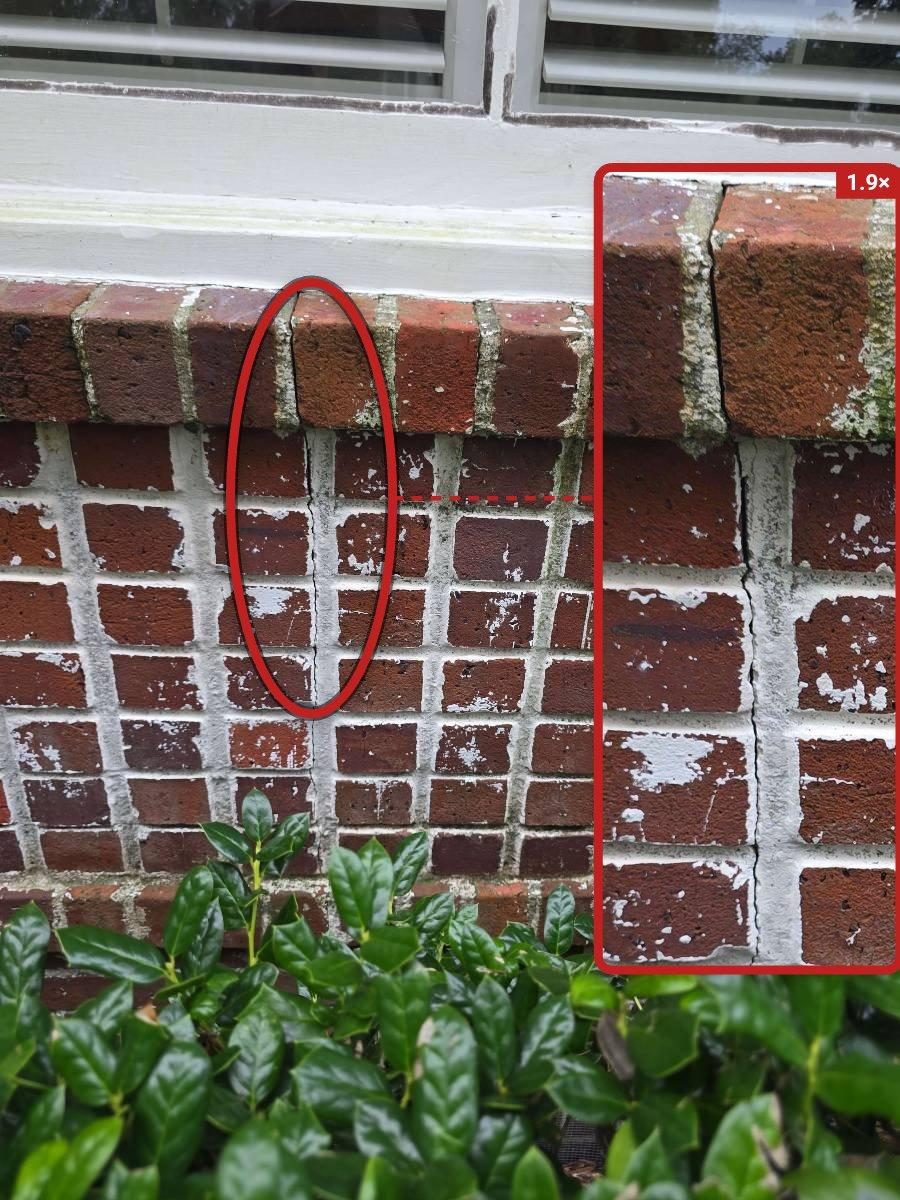
Stepped cracks in the brick veneer span from the front corner across a window and up to the roofline
What we found
The brick veneer — the single layer of brick on the outside face of the wall — showed stepped cracking (cracks that travel along the mortar joints in a stair-step pattern) at two separate locations: the front right area of the building and the rear right area. Near the front, hairline vertical cracks appeared below the window to the right of the front door, and continuing around that corner, cracking was visible above a window opening and ran up to where the roof meets the wall, in front of the chimney. The inspector noted that these cracks were wide enough to allow water to enter.
Why it happens here
Brick veneer is a decorative and weather-resistant outer layer — it is not structural, but it is the first line of defense against rain. Mortar joints, the cement-based material between bricks, are the weakest points in that layer, so when the veneer is stressed or the surface beneath it shifts, cracks tend to follow those joints in a step pattern. A stepped pattern that runs across more than one area of a building can be associated with differential settlement — meaning one part of the foundation has moved differently from another. Cracks wide enough to admit water allow moisture to reach the wall assembly behind the veneer, where it is hidden from view.
What it means for you
Water that enters through open cracks in the veneer reaches parts of the wall that cannot be seen without opening the wall. Separately, cracking across multiple zones and above a window opening — a structurally sensitive location — warrants a closer look at what is happening at the foundation level.
What to do
Have a licensed structural engineer evaluate the cracking before your inspection contingency — the deadline in your contract to complete inspections — expires. The engineer can assess the cause and extent of any movement and specify what repairs are needed.
How common is this
Stepped cracking in brick veneer is something inspectors actively look for and regularly include in reports. Getting a structural engineer's opinion before closing is a routine next step when this pattern appears.
Your inspector's job is to show you what is there — the structural engineer's job is to tell you what it means for the building.
Curious what's on record for a specific address?
Look it up on PermitSearch → (opens in a new tab)Ready to book your own inspection?
Schedule an inspection →