
The AC Was Running. It Just Wasn't Cooling Much.
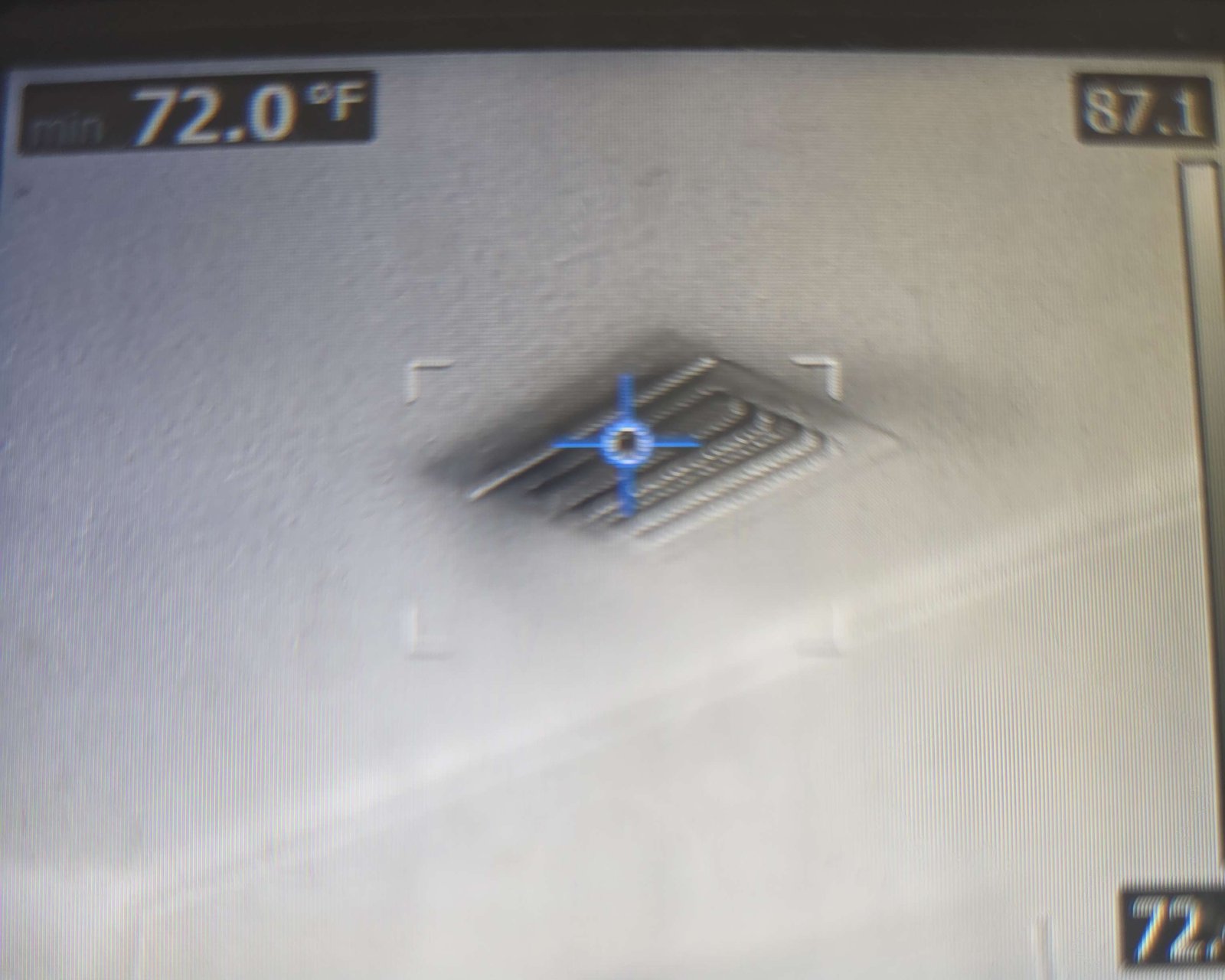
What we found
The air conditioner ran the whole visit without complaint. But when we measured the difference between the air going into the system and the cooled air coming out of the vents — inspectors call this the temperature split — it came to about 10 degrees. A healthy system typically delivers a split in the 14-to-20-degree range. The thermal camera in the photo is how we read the vents without a ladder under every one.
Why it happens here
A weak split usually traces to one of three things: the refrigerant charge is low (refrigerant is the working fluid that actually moves the heat outdoors), airflow is restricted somewhere — a clogged filter, a dirty coil, a crushed or leaky duct — or a component is simply wearing down. August in North Florida is the season that exposes it: systems run flat-out, and one that's underperforming can't hide.
What it means for you
The house may still reach the temperature you set — it just takes longer, runs more hours, and shows up on the electric bill. The harder the system works to compensate, the faster it wears. A 10-degree split isn't proof anything has failed; it's a measured signal that the system isn't delivering what it should, and that deserves a diagnosis rather than a shrug.
What to do
Have an HVAC contractor diagnose the cause before your inspection contingency expires — the contract window where findings can still be negotiated. The fix might be as small as a coil cleaning or topping off the charge; it might be the first sign the compressor is tiring. Either way, you want the number attached to a cause before you own it.
How common is this
Common — especially in the summer months, and especially on systems past their first decade. It's exactly why we measure instead of settling for "the AC turned on." Plenty of systems turn on. The number tells you whether they're doing their job.
"The AC works" and "the AC is doing its job" are two different claims. Only one of them comes with a number.
Curious what's on record for a specific address?
Look it up on PermitSearch → (opens in a new tab)Ready to book your own inspection?
Schedule an inspection →