

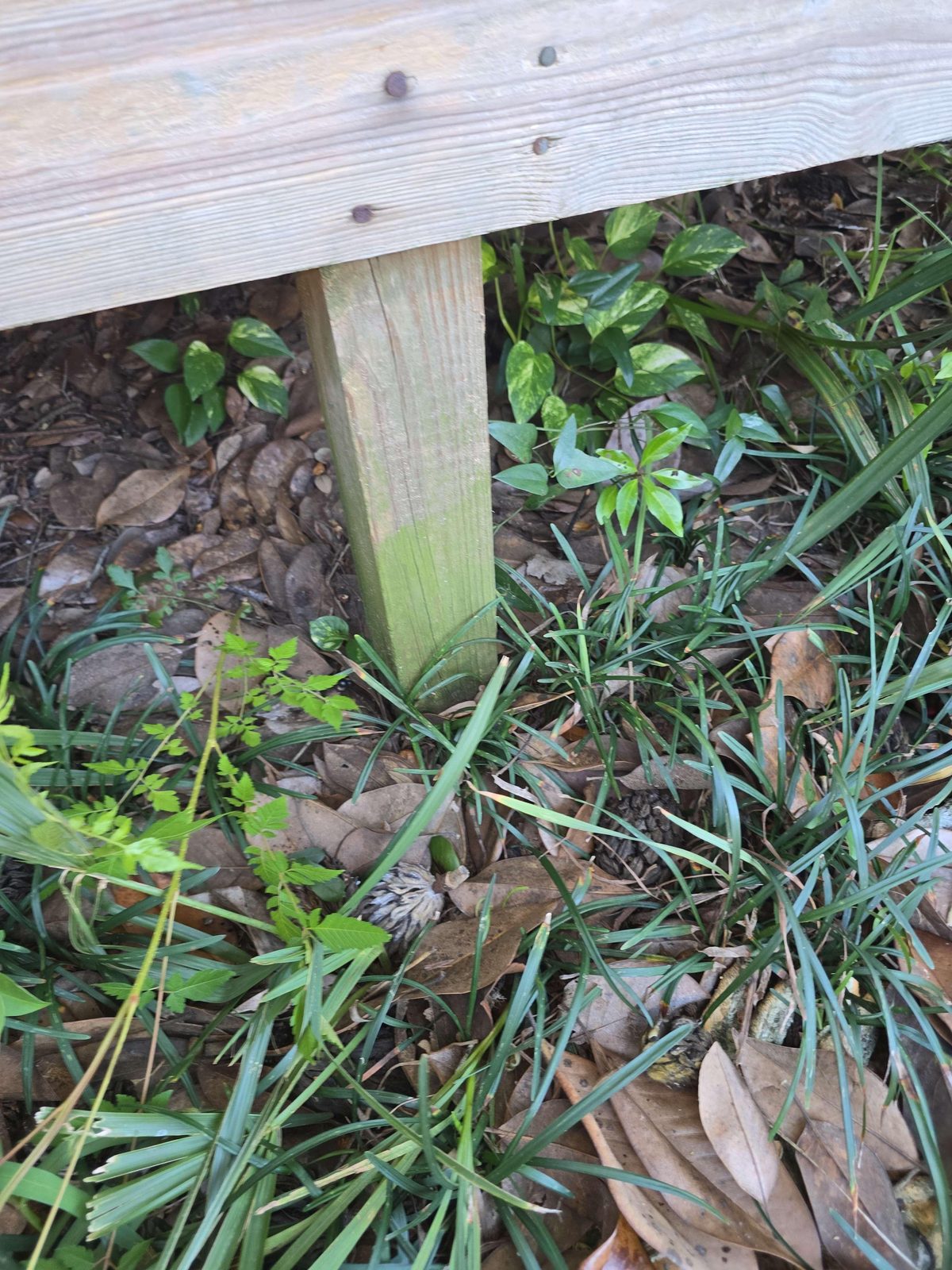
The deck posts are set directly into the soil rather than anchored to concrete footings
What we found
The deck's support posts are buried directly in the soil in the manner of fence posts. The framing connections also lack hardware designed to resist uplift — the force that tries to pull a structure upward or apart.
Why it happens here
Deck posts are meant to transfer the weight of the deck down into the ground through a concrete footing — a poured base sized to spread that load across a wide enough area of soil. When a post sits in soil instead, it has no rigid base to bear against. Separately, uplift-resistance hardware at the connections between posts and beams keeps those joints from pulling apart when the structure is pushed or lifted by wind or other forces. Without that hardware, the connections rely on the fasteners alone.
What it means for you
A post set in soil does not have the stable base that a footing provides, which affects the deck's ability to stay level and secure. The framing connections, without uplift-resistance hardware, are not configured to handle forces that act against gravity.
What to do
Have a licensed contractor or structural engineer evaluate the deck's foundation and framing connections and bring them to an accepted structural standard.
How common is this
Deck foundation and connection details are something inspectors routinely examine and report on. Corrections to footing and hardware conditions are a standard category of deck repair work.
Your inspector flagged this so you can go into any contractor conversation — or your negotiation — with a clear picture of what the deck's structure currently looks like.
Curious what's on record for a specific address?
Look it up on PermitSearch → (opens in a new tab)Ready to book your own inspection?
Schedule an inspection →